 Mykonos Photoshoot
Drone Rules in Mykonos: What the Law Actually Allows
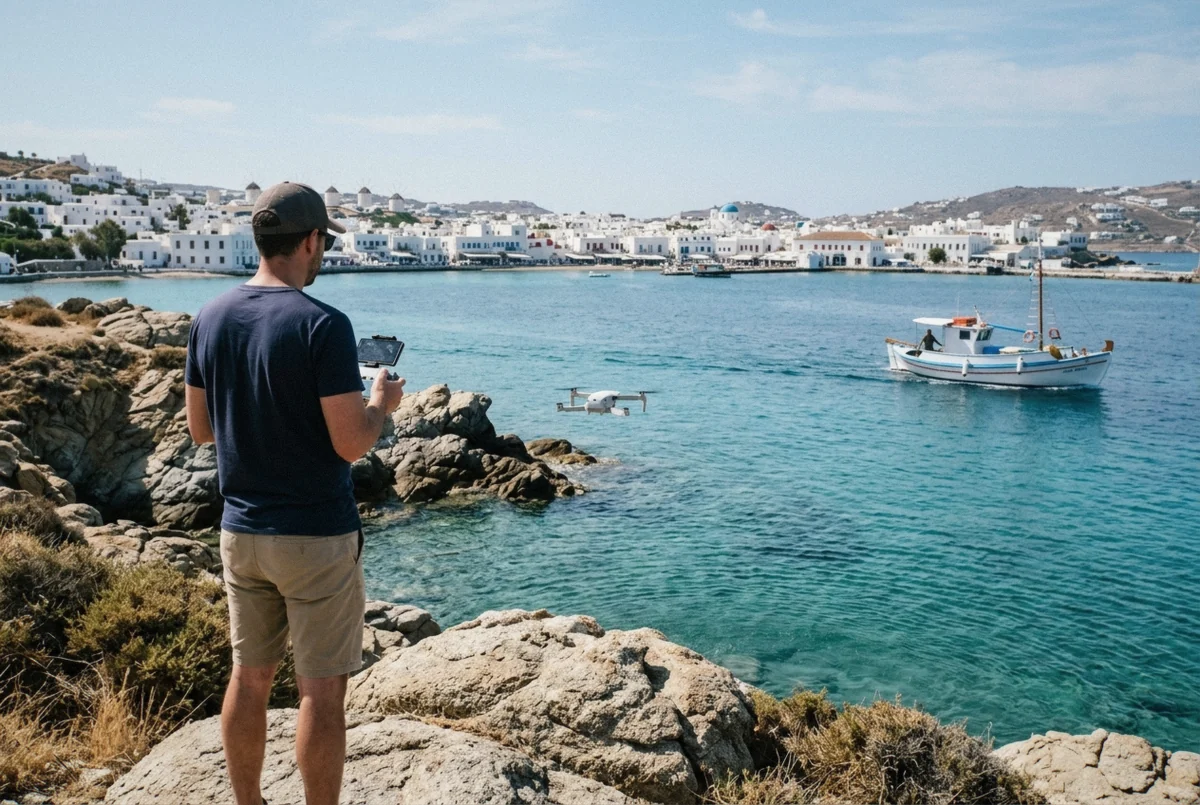
Drone rules in Mykonos are not a Mykonos law at all: they are the EU's open-category framework, a 120-metre ceiling and three subcategories, applied in Greece by the Hellenic Civil Aviation Authority through a single platform called Drone Aware GR. Most of what gets repeated about "no-fly zones" and fines online is guesswork dressed as fact. This page sticks to what the regulation says: the altitude ceiling, the distance rules by subcategory, why Chora itself is a bad idea in season regardless of the rulebook, and what Delos requires that a normal open-category flight does not. If a drone is not going to work for your trip, every Mykonos photoshoot package on the island gets the elevated shot without one.
Quick answer 120 m ceiling, registration even under 250 g, check DAGR first
Greece flies drones under the EU's open category, the same framework as every other EU state: a 120-metre altitude ceiling, and three subcategories, A1, A2 and A3, that set how close you may fly to uninvolved people. The single authority that matters is the Hellenic Civil Aviation Authority (HCAA), and the single tool that matters is Drone Aware GR (DAGR) at dagr.hasp.gov.gr, the platform that shows you, live, which airspace zones are open, restricted or need authorization before you fly. Registration is required even for a sub-250g camera drone. Only toy drones with no camera and no sensors are exempt.
Key takeaways
- Check dagr.hasp.gov.gr before you fly, not a blog post. That platform is the only authority on where you are standing
- A camera-equipped drone under 250g still needs operator registration. The weight exemption only covers cameraless toy drones
- Chora sits inside Mykonos International Airport's airspace and fills with crowds in season, a combination that makes legal open-category flight over the town center effectively unavailable, not merely discouraged
- Delos is a protected archaeological site. Flying there, or shooting a professional session there at all, needs Ministry of Culture permission arranged in advance. The photo-spots map shows the Delos view from Agios Ioannis Beach instead
- For the frames a drone would normally get, the flying dress operator's own site already advertises drone cinematography as part of its package, so hiring that compliance beats flying your own over town
The Rules That Apply Here Are EU Rules
Greece does not run its own separate drone code. It applies the European Union Aviation Safety Agency's (EASA) open-category regulation, the same rulebook that covers recreational and light commercial drone flight across the EU. The national authority responsible for enforcing it is the Hellenic Civil Aviation Authority (HCAA), and the practical tool built for pilots is Drone Aware GR (DAGR) at dagr.hasp.gov.gr, a live map that shows every airspace restriction in the country and lets you submit flight requests where authorization is required.
That single fact, check DAGR before you fly, replaces most of what gets repeated as folk knowledge about Greek drone rules. The map changes with airport traffic, event permits and seasonal restrictions, and a static list published anywhere, including this page, cannot substitute for it.
The open category itself is deliberately broad. It covers drones up to 25 kg flown below 120 metres, so a visiting photographer does not need a full aviation operator's certificate to fly a small camera drone over open ground. Broad does not mean unregulated: every flight still has to respect the altitude ceiling, the distance rules by subcategory below, and whatever DAGR says about the specific patch of sky above you that day. Treat the framework as a floor, not a guarantee. The rules can allow a flight in principle while a local restriction, a temporary event, or the airport's own traffic still closes it in practice.
Open Category: Altitude and Distance by Subcategory
The open category caps every flight at 120 metres above ground level. Which subcategory you fly under, and that depends on your drone's class mark, decides how close you may legally get to people who are not part of your flight.
The table sets each open-category subcategory against the drone class marks it accepts, the distance rule and the pilot training, as published on EASA's open-category page. All three share the 120-metre ceiling.
| Subcategory | Drone class | Distance from uninvolved people | Pilot training |
|---|---|---|---|
| A1 | C0 (under 250 g) or C1 (under 900 g) | May overfly individuals, never assemblies of people. C1 overflight should be minimised | C0: read the manual. C1: A1/A3 online training and exam |
| A2 | C2 (under 4 kg) | 30m, or 5m in the drone's low-speed mode | A2 certificate: A1/A3 training, practical self-training and an extra exam |
| A3 | C3 or C4 (under 25 kg) | 150 m from people and from urban areas | A1/A3 online training and exam |
Registration: Yes, Even Under 250 Grams
The 250-gram threshold gets misquoted constantly. It does not mean small drones are exempt from registration: it means a drone under 250g with NO camera and NO sensors is exempt, a genuine toy. The moment a drone carries a camera, and every drone anyone brings to photograph Mykonos does, the operator has to register, regardless of how light the airframe is. A DJI Mini with a camera still needs operator registration under this rule, and so does anything heavier.
Registration happens once, through your home EU member state if you already hold one, or through Greece's own process if you do not. It has nothing to do with which subcategory you fly under once you are in the air. It is a separate, mandatory step that comes first, and it is the piece most first-time visitors skip because the weight-based headline they remember from a forum post never mentioned the camera clause. The pilot has a separate requirement too: under EASA's open-category rules the remote pilot of a class-marked drone that is not a toy must be at least 16, and a member state may lower that to 12.
Worth saying plainly: registration is not the same thing as a Mykonos-specific flying permit, and holding a valid operator number does not by itself clear you to fly over Chora, over an assembly of people, or over Delos. It is the baseline requirement underneath all of the location-specific rules that follow.
What a Drone Sees Over Mykonos
Aerial footage of Mykonos and the Cyclades by an independent filmmaker, shown for the kind of frame a drone gets. The clip says nothing about how its flights were authorized, which DAGR decides flight by flight.
Why Chora Is Effectively Off the Table in Season
Nobody needs to publish a Mykonos-specific ordinance to make flying over the town center a bad idea. Two facts do it on their own. First, Mykonos Airport (JMK) sits about 3.5 km from Chora, a 10-minute drive, and airport proximity is exactly the kind of thing DAGR flags as controlled or restricted airspace. Check the map for the current status before assuming anything is open. Second, even where the airspace itself is flyable, A1, the subcategory that allows overflying individuals, explicitly never permits flying over an assembly of people, and Chora's lanes, the windmill ridge and Little Venice are full of exactly that kind of crowd for most of the season.
Put those two together and the honest read is not "drones are banned in Chora." It is that the combination of controlled airspace near the airport and a town permanently full of pedestrians makes legal open-category flight over the town center effectively unavailable in season. This page will not print an exclusion radius around the airport, since the restricted zone is drawn on DAGR's live map, the only source that can answer that question correctly on the day you fly.
Delos: a Permit, Not an Overflight
Delos is a 3.43 km² island a short boat ride from Chora, on the UNESCO World Heritage List since 1990 for its archaeological site, and it sits outside the normal open-category conversation entirely. Drone flights there, and professional photo shoots of any kind, camera on a tripod or camera in the air, require permission from Greece's Ministry of Culture, arranged well ahead of a visit. No session on this site includes Delos for exactly this reason, and no operator can promise it as a location without that paperwork already in hand.
If Delos matters to your trip, the full spot-by-spot map covers what a personal camera on the visitor paths can and cannot do there, and which beach frames the island as a sunset silhouette from Mykonos.
What to Do Instead of Flying Your Own
The practical answer for most visitors is not to fight the airspace, it is to hire the compliance instead of carrying it yourself. The flying dress operator's own site advertises drone cinematography as part of its packages, meaning the operator already holds the registration, the local authorizations and the working knowledge of which day's DAGR map allows what. Booking that session gets you the aerial footage without the legal exposure of flying an unregistered or unauthorized drone over a crowd yourself, and without the risk of a confiscated aircraft if a restriction turns out to apply that a visitor had no way of checking in advance.
For everything else, the honest move is ground-level frames that read as aerial. An elevated viewpoint like Boni's Windmill, a 10-minute walk past the main windmill row, or a wide frame from the 1 to 2 hour custom-route session shot from a rooftop terrace or a hillside, delivers most of the same visual payoff, height, scale, the town laid out below, without a single registration form. The full photo-spots map marks exactly which elevated viewpoints work for this, and several of them were picked specifically because they give a drone's-eye feel from solid ground.

Quick Reference Before You Fly
None of this replaces checking DAGR yourself on the day. It is the shortlist of what to have settled before you even open the app.
The table answers the questions most visiting pilots ask, each drawn from the EASA open-category rules or the HCAA framework described above, in the order you hit them.
| Question | Answer |
|---|---|
| Is my drone registered? | Required if it has a camera or sensors, regardless of weight |
| How old must the pilot be? | 16 for a class-marked drone that is not a toy. A member state may lower it to 12 |
| Which authority governs this? | Hellenic Civil Aviation Authority (HCAA), under EU open-category rules |
| Where do I check live airspace? | dagr.hasp.gov.gr, the Drone Aware GR platform |
| Can I fly over Chora in season? | Effectively no: airport proximity plus crowds rule out legal open-category flight over the town center |
| Can I fly over or shoot Delos? | No without Ministry of Culture permission, arranged in advance |
| What's the altitude ceiling? | 120 metres above ground level, open category, island-wide |
Mykonos Drone Rules: What Pilots Ask
Can a tourist fly a drone in Greece?
Yes, under the EU's open category, the same rules that apply to any EU visitor. You need a registered operator account, and you need to check dagr.hasp.gov.gr for the specific location and date, since restricted zones around airports and protected sites change what is actually flyable.
Can I take my drone to Santorini?
The same EU open-category framework and the same DAGR platform apply across every Greek island, Santorini included. The specifics differ, Santorini has its own airport and its own crowded caldera-rim towns, so check DAGR for that island separately rather than assuming Mykonos's answer carries over.
What countries can you not bring a drone into?
That varies by country and changes often enough that a general list goes stale fast. Several countries require an import permit or ban civilian drones outright. For Greece specifically, bringing a drone in is not restricted, while flying it once you arrive is what the open-category rules and DAGR govern.
Do I need a permit to fly a drone in Europe?
Not a blanket permit for casual open-category flying, but you do need operator registration, and specific locations, controlled airspace, protected sites, event zones, can require an authorization request through the relevant national platform, DAGR in Greece's case.
Is Drone Aware GR mandatory to use?
It is the tool HCAA provides to check airspace status and submit authorization requests, and given how much of Mykonos sits near the island's airport and how many of its landmarks draw crowds, treating it as mandatory before any flight is the only responsible approach.
Do I need to register a drone under 250 grams?
If it has a camera or sensors, yes. The sub-250g exemption only covers toy drones with neither, which rules out essentially every drone anyone brings on a photography trip.
The rules here are not exotic, they are the EU's open category applied by HCAA through one live platform. What makes Mykonos specific is the airport sitting close to a town that is full of people for most of the season, a combination that turns a technically-legal flight into a practically bad idea. Check DAGR, register the drone, and for the shots that matter most, Mykonos photoshoot packages already include an operator who has done the paperwork for you.
If the aerial footage is an add-on rather than the point, what that adds to the price is worth checking before you book.